Hierarchy of Criminal Courts in India
Hierarchy of Criminal Courts in India
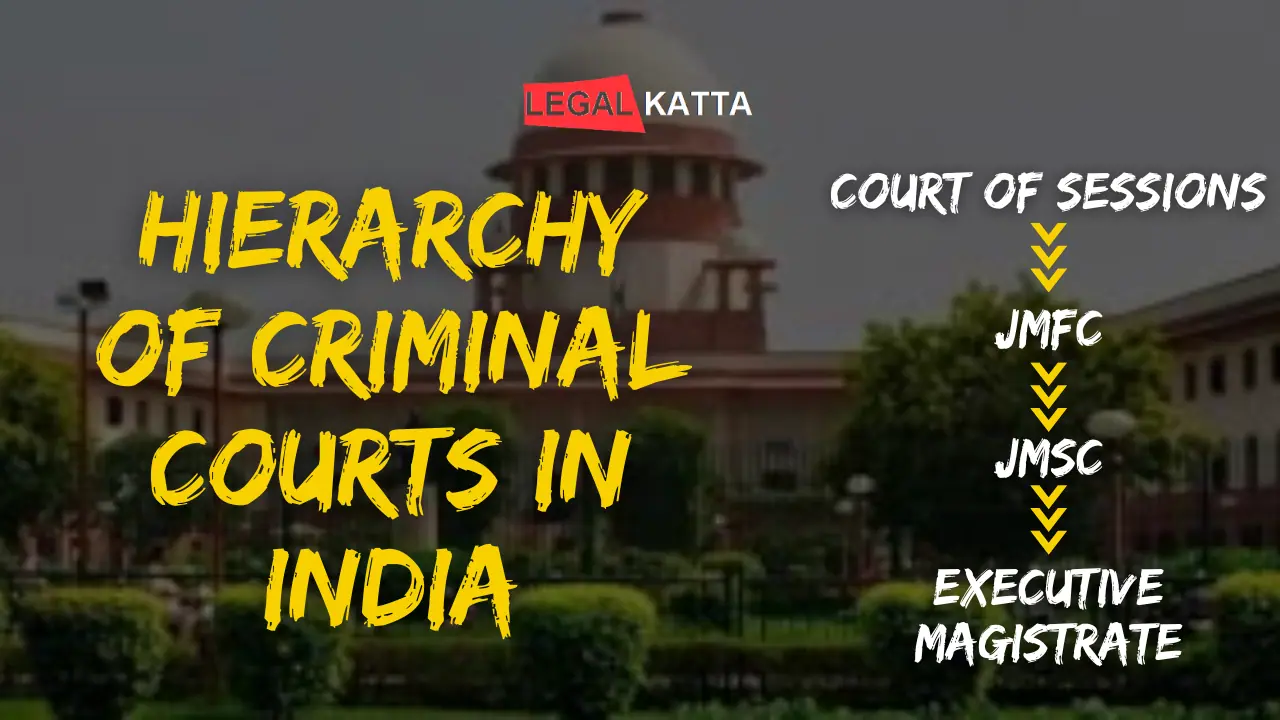
Hierarchy of Criminal Courts in India has been discussed in this article. Here, we have provided hierarchy of criminal courts in India given under BNSS, 2023
Hierarchy of Criminal Courts in India under BNSS, 2023;
- Supreme Court
- High Court
- Court of Sessions
- Chief Judicial Magistrate
- Judicial Magistrate of First Class
- Judicial Magistrate of Second Class
- Executive Magistrate
Supreme Court of India
The Supreme Court of India is the highest criminal court in India. The Supreme Court has jurisdiction over criminal cases all over India.
The Supreme Court of India has Original, Appellate and Advisory jurisdiction. The Supreme Court’s original jurisdiction extends to any dispute between the Government of India and any State or States on one side and one or more States on the other or between two or more States.
Article 32 of the Constitution of India, gives an exclusive original jurisdiction to the Supreme Court regarding enforcement of Fundamental Rights. The Supreme Court is empowered to issue directions, orders or writs, including the writs of Habeas Corpus, Mandamus, Prohibition, Quo-warranto and Certiorari to enforce them.
The Supreme Court has been conferred with the power to transfer any civil or criminal cases from one State High Court to another State High Court or from a court subordinate to another State High Court.
The Appellate jurisdiction of the Supreme Court of India can be invoked by a certificate granted by the High Court concerned under Articles 132(1), 133(1) or 134 of the Constitution of India in respect of any judgment, decree or final order of a High Court in both civil and criminal matters.
High Courts
The High Court stands at the head of a State’s judicial administration. Every High Court comprises a High Court Chief Justice and other judges.
Article 226 of the Constitution of India, gives power to every High Court to issue to any person within its jurisdiction directions, orders or writs including writs which are like habeas corpus, mandamus, prohibition, quo-warranto and certiorari for the enforcement of fundamental rights and any other purpose.
Every High Court has powers of superintendence over all courts within its jurisdiction. The High Court is empowered to call for returns from such courts, make general rules and prescribe forms to regulate their practice and proceedings and determine the manner and form in which book entries and accounts shall be kept.
Hierarchy of Criminal Courts in India Under BNSS
According to section 6 of Bharatiya Nagarik Suraksha Sanhita 2023, the classes of criminal courts in every State apart from the High Courts and the Supreme Court, namely;
- Court of Session,
- Judicial Magistrates First Class,
- Judicial Magistrate Second Class,
- Executive Magistrates.
Court of Sessions
Section 8 of BNSS, 2023 states that at every sessions division, the court of sessions shall be established by the State Government. Every court of session shall be presided over by the judge appointed by the High Court. The High Court may also appoint Additional Sessions Judges and Assistant Sessions Judges to exercise jurisdiction in a Court of Session.
The Sessions Court ordinarily sits at such place or places as ordered by the High Court, but if in a case, the Court of Sessions decides to cater to the general convenience of the parties and witnesses, then it may with the consent of the prosecution and the accused preside its sittings at any other place. The Assistant Sessions Judges are answerable to the Sessions Judge.
The Sessions Judge may also make provision for the disposal of any urgent application, in the event of his absence or inability to act, by an Additional Sessions Judge or if there be no Additional Sessions Judge, by the Chief Judicial Magistrate, and such Judge or Magistrate shall be deemed to have jurisdiction to deal with any such application.
Court of Chief Judicial Magistrate
Section 10 of BNSS, 2023, states that in every district, the High Court shall appoint a Judicial Magistrate of the First Class to be the Chief Judicial Magistrate. the High Court may appoint any Judicial Magistrate of the First Class to be an Additional Chief Judicial Magistrate and such Magistrate shall have all or any of the powers of the Chief Judicial Magistrate under this Sanhita or under any other law or time being in force as the High Court may direct.
Court of Judicial Magistrate First Class and Second Class
Section 9 of BNSS, 2023, states that in every district there shall be established as many Courts of Judicial Magistrates of the First Class and of the Second Class. The presiding officer of the courts of judicial Magistrates of the First Class and of the Second Class shall be appointed by the High Court and at such places, as the state government may after consultation with the High Court
The State Government establish one or more special courts of Judicial Magistrates of the First Class or of the Second Class to try any particular case our particular class of cases and where any such special code is established, no other court of the Magistrate in the local area shall have jurisdiction to try any case or class of cases for the trial of which the special code of judicial magistrate has been established.
Executive Magistrate
Section 14 of BNSS, 2023, states that in every district, Executive Magistrates shall be appointed by the State Government as many persons as it thinks fit and shall appoint one of them as District Magistrate. All Executive Magistrates are subordinate to the District Magistrate. The District Magistrate from time to time make rules or give special orders as to distribution or allocation of business among the executive magistrates subordinate to him.
Read Also:
- Difference Between FIR and Complaint
- Difference Between Summons Case and Warrants Case
- Rights of Arrested Person Under BNSS
Frequently Asked Questions
What is the hierarchy of criminal courts in India?
Hierarchy of Criminal Courts in India – 1. Supreme Court, 2. High Court, 3. Court of Sessions 4. Chief Judicial Magistrate 5. Judicial Magistrate of First Class 6. Judicial Magistrate of Second Class 7. Executive Magistrate
What is section 8 of BNSS, 2023
Section 8 of BNSS, 2023 deals with the establishment of court of Session. Session Judge is appointed by the High Court.
Conclusion
Hierarchy of criminal courts in India has been provided in Bharatiya Nagarik Sureksha Sanhita, 2023. Also, these courts established in India vested different powers. The court rooms are the premises where the people can get their complaints and gets their disputes resolved. The hierarchy of criminal courts in India and powers of these criminal courts can be found in BNSS, 2023